Samsung's Galaxy glasses have no display. Here's why they aren't XR glasses
Samsung's first smart glasses start at $395 and ship December 10. There's no screen in the lens, though. Here's what they do and what to get instead.
Samsung's first smart glasses are up for pre-order now, from $395. Per Samsung, they ship in the US on December 10. They run Android XR, Google's software for headsets and glasses, in frames designed with Warby Parker and Gentle Monster. You might see them called Galaxy Glasses or Samsung's XR glasses.
Here's the catch: there's no screen. Nothing shows up in the lens. You can't watch a movie on them, read a text in your view or plug in a Steam Deck. That's why we don't count them as XR glasses, and why you won't find them in our compatibility checker.
Note
We haven't tried Samsung's glasses. This post is based on Samsung's own announcements, Google's developer docs and reports on Warby Parker's and Gentle Monster's launch plans. Samsung announced the price and ship date on November 12.
Status
| Name | Samsung calls them "intelligent eyewear" |
| Display | None |
| Pre-orders | Open now at Warby Parker and Gentle Monster |
| Price | From $395, per Samsung |
| On sale | December 10, per Samsung |
| First markets | US and South Korea, per Google |
| Phone | Recent Galaxy, Pixel 7 and up, iPhone 13 Pro and up |
Price and where to buy
Samsung's price list is short:
- Warby Parker: from $395. Google says that covers both the optical and the sun styles.
- Gentle Monster: $449 to $489, depending on the frame.
There are 30 designs in all. Google says prescription options are available for most frames. Nobody has said yet what prescription lenses add to the price.
Pre-orders are open on both brands' websites and in their stores. Everything ships on December 10, when Samsung says demos also start at select Samsung stores.
What they actually do
They're built around Gemini, Google's AI assistant. The frame holds a camera, microphones and speakers. Samsung's July announcement lists what that adds up to:
- Summing up long messages and reading key details aloud
- Live translation
- Directions, and answers about what's around you
- Capturing what you're looking at, like a whiteboard, into Samsung Notes
- Sharing your view on a call, or recording what you see
You control them by voice and a touchpad on the side. With a Galaxy Watch9, you can use hand gestures too. Samsung quotes up to nine hours of battery, and the case holds up to seven more full charges. Inside is Qualcomm's Snapdragon AR1 Gen 1 chip, and Android Headlines reports a 12MP camera.
Answers come back as sound in your ears, or on your phone. 9to5Google sums them up as "audio-only glasses without an in-lens display."
Why it sounds like they have a screen
It's an easy mix-up, and the marketing doesn't help.
- The name. They run Android XR. "XR" suggests a screen, but here it's just the name of Google's platform. It also runs Samsung's Galaxy XR headset and the XREAL Aura.
- The pitch. Samsung says the eyewear "brings AI directly into the user's line of sight." That's about the camera seeing what you see. Nothing appears in front of your eyes.
- The light inside. Samsung says there's an LED on the inside of the frame. It tells you when the camera is recording. It isn't a display.
Neither Samsung's July announcement nor its interview with the head of its XR team mentions a display at all.
What makes glasses XR
XR, or extended reality, covers VR, AR and mixed reality. All three put digital images in front of your eyes. With no display, there are no images to add to your view.
Google draws the same line in its Android XR developer docs. It puts glasses like the XREAL Aura in a group called wired XR glasses, which overlay digital content on the room you see through the lenses. Samsung's kind lands in a separate group, audio glasses and display glasses, which Google calls intelligent eyewear for all-day wear. Samsung's own newsroom calls them AI glasses.
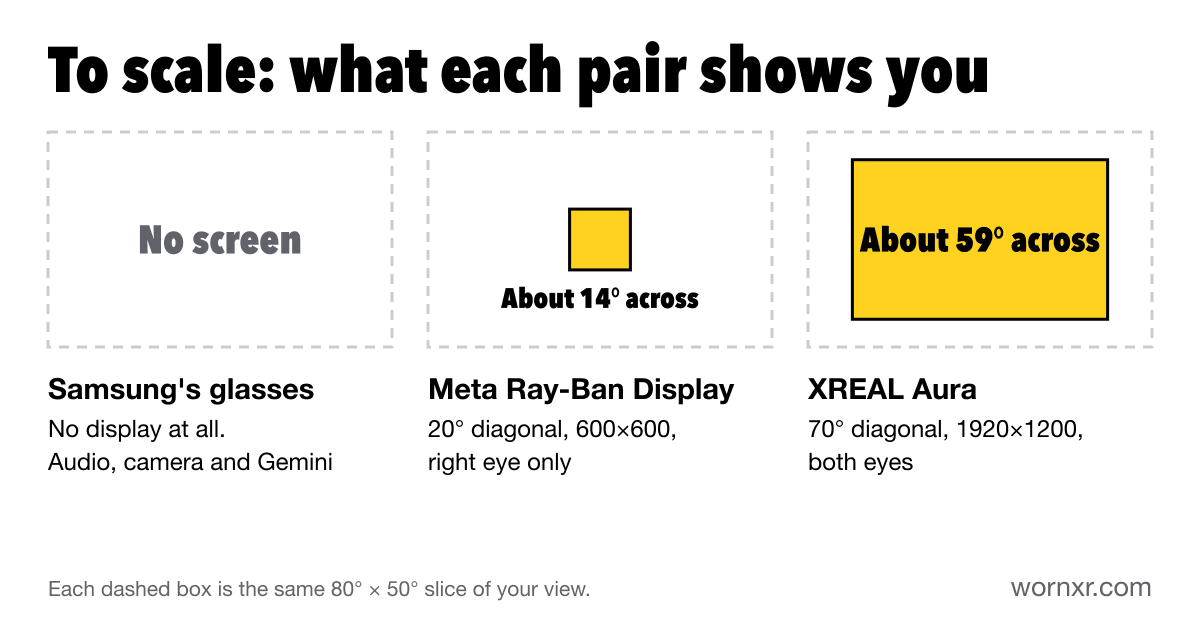
Here's what each kind shows you, drawn to scale:
| Kind | Example | What you see | Best for |
|---|---|---|---|
| AI glasses | Samsung's intelligent eyewear | Nothing. You hear the answers. | Hands-free help, photos and calls |
| AI glasses with a screen | Meta Ray-Ban Display, $799 | A small screen in one eye, 20° | Quick looks at info on the go |
| XR glasses | XREAL Aura, $1,099 | A big screen in both eyes, 70° | Movies, games and work |
Tethered display glasses, like the XREAL 1 Pro+, also give you a big screen in both eyes. They just borrow the brains of whatever you plug them into. For every name you'll see in stores, here's what AR, XR, AI and smart glasses each mean.
Which phone you'll need
Good news: it's not just Galaxy phones. Samsung's spec sheet lists three groups:
- Galaxy: S, S FE, Z Fold, Z Flip and Fold Ultra phones on One UI 9.0 or newer
- Pixel: Pixel 7 and newer, with the Android 17 September 2026 update
- iPhone: iPhone 13 Pro and newer, per Google
Android Authority reports that other Android phones aren't supported at launch. A Galaxy phone still gets the most out of them. Samsung says Bixby only works with Galaxy phones, and some of the processing runs on the phone, so it does real work here.
Gemini needs a Google account and an internet connection. Google says the glasses only work with US and South Korean Google accounts for now.
When a version with a screen arrives
Not this year. Android Headlines reports that Samsung is working on a version with a display, due later. At Google I/O in May, Google signaled that Android XR glasses with displays won't reach stores before 2027.
Even then, expect a small screen for quick looks, not a giant virtual monitor. Our Android XR glasses tracker follows the timeline.
What this means for you
You want a big screen for movies, games or work. Don't wait for Samsung. Display glasses do that today, and they plug into the phone, laptop or handheld you already own. On a Galaxy phone? Here's which Galaxy phones work with AR glasses, with DeX for a desktop on the go. Flying soon? See our best AR glasses for flights. Gaming on a handheld? Start with our Steam Deck picks.
You want apps on a big screen without a phone or laptop. That's the XREAL Aura, the first Android XR glasses with a screen. It ships from mid-November.
You want hands-free help, photos and calls. Samsung's glasses could suit you, especially with a Galaxy phone. Try a pair on first. Google says you can book a guided demo at more than 360 Warby Parker stores. Samsung adds demos at select Samsung stores from December 10.
You want a small screen for quick looks. Wait for the display version, or look at Meta's Ray-Ban Display now. Curious how small a one-eye screen really is? Here's what the Raven Prism 1's 720×720 display can and can't do.
You'd rather not wear a camera at all. Samsung's glasses are built around one. Most display glasses have none. Here's which AR glasses have a camera, and which don't.